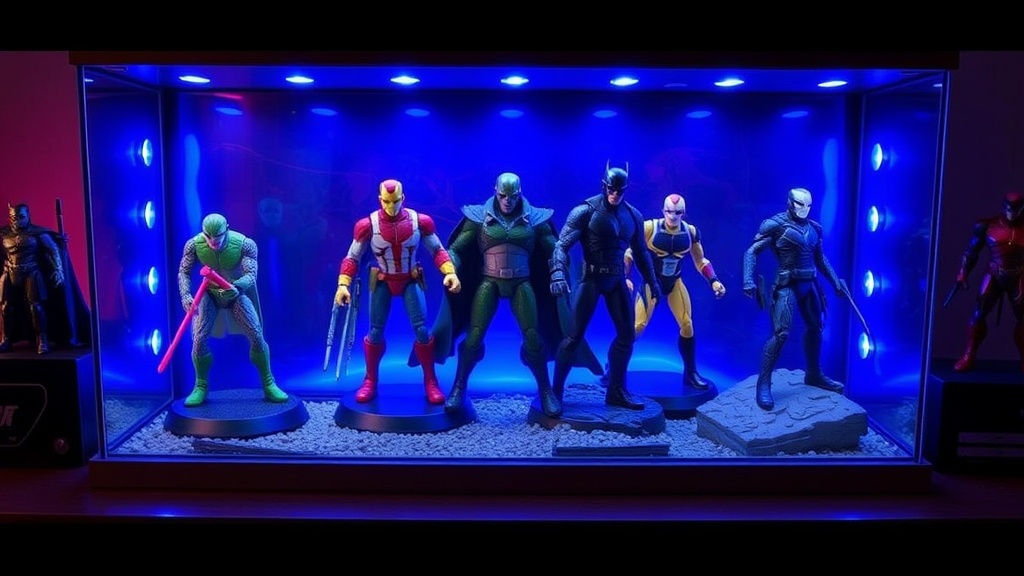
How to Build Custom LED Display Cases for Your Action Figures

What This Guide Covers (and Why LED Cases Matter)
Standard bookshelves don't do justice to a carefully curated collection. This guide walks through building custom LED display cases that protect figures from dust, UV damage, and the chaos of everyday life while making them look like gallery pieces. Whether you're housing vintage Star Wars Kenner figures or modern Marvel Legends releases, proper lighting transforms a cluttered shelf into something worth showing off.
The process isn't complicated. You don't need a workshop full of tools or years of carpentry experience. What you need is a clear plan, the right materials, and about a weekend of focused effort.
What Materials Do You Need to Build a DIY LED Display Case?
The essentials include acrylic or glass panels, LED strip lights, a basic frame material (MDF, aluminum, or hardwood), and mounting hardware. Most projects run between $80 and $300 depending on size and material quality.
Here's a breakdown of what works:
| Material | Best For | Price Range | Notes |
|---|---|---|---|
| Acrylic (1/4") | Lightweight, shatter-resistant cases | $30-$60 per sheet | Scratches easily; use microfiber cloths only |
| Tempered Glass | Premium displays, UV protection | $50-$100 per sheet | Heavier; requires sturdier framing |
| MDF with veneer | Budget builds, painted finishes | $20-$40 per case | Sealed edges required; swells with moisture |
| Aluminum extrusion | Modular, expandable systems | $60-$120 per case | Compatible with 2020-series T-slot accessories |
| Hardwood (oak, maple) | Heirloom-quality displays | $80-$200+ per case | Requires joinery skills or pocket-hole jigs |
For LED lighting, skip the cheap Amazon strips that yellow after six months. Philips Hue Lightstrip Plus and Govee RGBIC strips offer better color accuracy and longevity. The slightly higher upfront cost pays off when your Transformers collection still looks vibrant three years later.
Don't forget the small stuff: corner brackets, magnetic catches for doors, diffusers for the LED strips (crucial for eliminating hotspots), and a quality power supply rated for your total wattage plus 20% headroom.
How Do You Plan the Layout and Lighting for Maximum Impact?
Start by measuring your figures, not your wall. A 6-inch Marvel Legends Spider-Man needs roughly 8 inches of vertical clearance to avoid looking cramped. Taller figures like Power Rangers Megazords or Hot Toys 1/6 scale pieces demand 12-16 inches per shelf.
Lighting placement matters more than most collectors realize. Top-down lighting creates harsh shadows under chins and helmet brims. The fix? Install LED strips along the front edge of each shelf, facing backward toward the figures. This "fill lighting" eliminates shadows and highlights sculpt details.
For multi-tier cases, consider color temperature carefully. Warm white (2700K) flatters older figures with muted paint apps. Cool white (5000K-6500K) brings out the vibrancy in modern releases. Here's the thing — mixing color temperatures in the same case looks amateur. Pick one and stick with it.
Austin collectors (and anyone in humid climates) should add small silica gel compartments behind the back panels. The Dry-Packs rechargeable canisters fit neatly into 1-inch aluminum U-channel and keep humidity below 50%.
Spacing Guidelines by Figure Type
- 3.75-inch vintage: 5-inch shelf height, 2-inch depth
- 6-inch modern (Marvel Legends, Black Series): 8-inch shelf height, 4-inch depth
- 7-inch scale (NECA, McFarlane): 9-inch shelf height, 5-inch depth
- 1/6 scale (Hot Toys, Sideshow): 16-inch shelf height, 8-inch depth
- Large vehicles/playsets: Custom height with removable shelves
The catch? Static shelving limits you later. Designing with adjustable peg holes or modular aluminum extrusion lets you reconfigure as collections change.
What Are the Step-by-Step Instructions for Building the Case?
This walkthrough assumes a basic three-shelf case (36" wide × 24" tall × 12" deep) using MDF and acrylic panels — a solid beginner project that teaches core skills without breaking the bank.
Step 1: Cut the frame pieces. You'll need two sides (24" × 12"), a top and bottom (36" × 12"), and three shelves (35.5" × 11.5" — the half-inch accounts for the side panel thickness). Use a circular saw with a guide for straight cuts, or have your local Home Depot make the cuts when you buy the sheet.
Step 2: Drill shelf pin holes. Mark lines every inch along the inside faces of both side panels. Use a shelf pin jig (the Kreg Adjustable Shelf Pin Jig runs about $35) to ensure straight lines. Wobbly shelves ruin the whole look.
Step 3: Assemble the box. Wood glue plus 1.5-inch screws at the corners. Pre-drill everything — MDF splits easily. Check for square by measuring diagonally corner to corner; both measurements should match within 1/16 inch.
Step 4: Cut the acrylic panels. Score-and-snap works for straight cuts under 24 inches. For the front door, leave the protective film on until final assembly. Drill slowly for handle holes; acrylic cracks under pressure.
Step 5: Install the LED strips. Clean shelf undersides with alcohol first. Mount strips 2 inches back from the front edge, facing backward. Solder connections between shelves or use snap connectors (less reliable but easier). Run wiring through small holes drilled in the back panel.
Step 6: Add the back panel and door. The back panel can be 1/8-inch hardboard — it's not load-bearing. Mount the acrylic door with small hinges (the Hickory Hardware 1-1/2 inch self-closing hinge works well) and a magnetic catch.
Test everything before sealing the case permanently. LEDs have a way of failing at the worst possible moment.
How Do You Maintain and Troubleshoot LED Display Cases?
Dust is the enemy. Even sealed cases accumulate it — through door gaps, ventilation holes, and static electricity that pulls particles to acrylic surfaces.
Clean acrylic with a dedicated plastic polish like Novus 1. Never use paper towels (they scratch) or ammonia-based cleaners (they craze the surface). Microfiber cloths only. For glass cases, standard glass cleaner works fine, though distilled water and vinegar avoids streaks better.
LED troubleshooting follows a pattern. If sections go dark, it's usually a bad solder joint or a dead section in the strip. Govee and Hue strips can be cut at designated points and rejoined with connectors — no soldering required for repairs. If the whole strip flickers, check your power supply rating. Underpowered supplies overheat and fail prematurely.
Worth noting: LED strips lose brightness over time. After about 30,000 hours (roughly 3.5 years of constant use), expect 70% of original output. This isn't catastrophic — most collectors don't notice gradual dimming. But if you're photographing figures for sale, replace strips every few years.
Quick Fixes for Common Problems
- Hotspots under figures: Add diffusion film (frosted packing tape works in a pinch) between the LED strip and the shelf above.
- Door won't stay closed: Upgrade to rare earth magnets; the 3M adhesive ones lose grip over time.
- Figure fading: Check your LED color temperature — cool whites emit more UV-adjacent wavelengths. Switch to warm white or add UV-filtering acrylic.
- Humidity fogging: Increase ventilation slightly or replace silica gel more frequently.
Advanced Upgrades Worth Considering
Once you've built a basic case, several upgrades separate hobby builds from serious displays.
Motion-activated lighting. PIR sensors wired inline with your power supply turn cases on when you enter the room. The Sensky BS010L sensor ($12) handles up to 60 watts and has adjustable sensitivity. That said, sensor placement matters — too sensitive and the case flickers on when you walk past the doorway.
Individual figure spotlights. For centerpiece pieces, small 3-watt puck lights aimed from the shelf above create dramatic pools of light. The AIBOO 3W Mini LED Downlights fit in 2-inch holes drilled through shelves. Wire them on a separate dimmer circuit for full control.
Background integration. Static backdrops get old fast. Some collectors mount thin LED panels behind translucent printed backgrounds — cityscapes for superheroes, space scenes for Star Wars, diorama textures for military figures. The Nanoleaf Canvas panels work surprisingly well for this, though they're overkill for smaller cases.
For those in the Austin area, TAP Plastics on South Lamar cuts custom acrylic to exact specifications with polished edges. The price beats online ordering once you factor in shipping costs for large sheets. They also stock extruded aluminum channel specifically designed for LED mounting — harder to find at big-box stores.
Building custom LED cases isn't about perfection. First attempts will have visible seams, slightly crooked shelves, and wiring that's messier than you'd like. The second case will be better. By the third, you'll have a system that rivals commercial display units costing five times as much. Start small, document your process, and treat each build as practice for the next.
Steps
- 1
Gather Materials and Measure Your Collection Space
- 2
Install LED Strip Lighting with Proper Spacing
- 3
Arrange Figures and Adjust Lighting for Best Display